Showing posts with label Women. Show all posts

October 24, 2019

Image of Godde


~ Beyond Gender ~

The Spirit of Godde
as mirrored in mortals is
seen not only in people called
’he’ as if our Creator were male
reflected only by males as
taught in the language of
patriarchy

The Spirit of our Creator
whose image, reflected in our
mothers and fathers since the day
of creation, echoes that essence
gifted to all - such mystery, for
Godde is Spirit and we but
mortal clay.

Mystery - for Godde is Spirit
not bound by human limitation, yet
most persist in naming our Creator ‘HE’
engraving an image on our mind’s eye
an exclusively male portrait which
blinds us to Divine seen also in 
our Moms

JoMae
10/23/19

December 21, 2018

Remembering The Women


~ A GENEALOGY OF JESUS CHRIST ~

A genealogy of Jesus Christ, the son of Miriam, the daughter of Anna:
Sarah was the mother of Isaac,
And Rebekah was the mother of Jacob,
Leah was the mother of Judah,
Tamar was the mother of Perez.
The names of the mothers of Hezron, Ram, Amminadab, 
     Nahshon and Salmon have been lost.
Rahab was the mother of Boaz,
     and Ruth was the mother of Obed.
Obed’s wife, whose name is unknown, bore Jesse.
The wife of Jesse was the mother of David.
Bathsheba was the mother of Solomon,
Naamah, the Ammonite, was the mother of Rehoboam.
Maacah was the mother of Abijam and the grandmother of Asa.
Azubah was the mother of Jehoshaphat.
The name of Jehoram’s mother is unknown.
Athaliah was the mother of Ahaziah,
Zibiah of Beersheba, the mother of Joash.
Jecoliah of Jerusalem bore Uzziah,
Jerusha bore Jotham; Ahaz’s mother is unknown.
Abi was the mother of Hezekiah,
Hephzibah was the mother of Manasseh,
Meshullemeth was the mother of Amon,
Jedidah was the mother of Josiah.
Zebidah was the mother of Jehoiakim,
     Nehushta was the mother of Jehoiachin,
Hamutal was the mother of Zedekiah.
The the deportation to Babylon took place.
After the deportation to Babylon
the names of the mothers go unrecorded.
These are their sons:
Jechoniah, Shealtiel, Zerubbabel,
Abiud, Eliakim, Azor and Zadok,
Achim, Eliud, Eleazar,
Matthew, Jacob and Joseph, the husband of Miriam.
Of her was born Jesus who is called Christ.
The sum of generations is therefore: fourteen from Sarah to David’s mother;
     fourteen from Bathshebba to the Babylonian deportation;
     and fourteen from the Babylonian deportation 
          to Miriam, the mother of Christ.
-Genealogy compiled by Ann Patrick Ware

This genealogy tracing Jesus’ great grandmothers was taken from Remembering the Women, a book of scripture readings that include women, compiled by J. Frank Henderson. ““A Genealogy  of Jesus Christ” was compiled by Ann Patrick Ware of the Women’s Liturgy Group of New York, who has graciously put this text in the public domain for all to use.” 
---------
During Advent, when many preach and reflect on the few women named in Matthew’s lineage, let’s also remember the many other mothers, both named and unnamed, both Hebrew and not, who were great grandmothers of Jesus. There are precious lessons to ponder here as well. Remembered here, of course, are mothers in Christ's paternal line. Mothers of the mothers are not recorded. -JoMae

May 11, 2018

Motherly Parent


Imperfect Praise

On Mother’s Day, let us celebrate and give
thanks for our Motherly Heavenly Parent
as we honor our Moms, created, with
our Dads, in Godde’s Divine image

Our Mothers, who in imperfection bore us
nurtured, led and sometimes punished 
reflecting the Presence of their own
Maker, Creator of all in perfection 

So today I give thanks for my Mom whose
life unwrapped for me the unconditional 
love of my Beloved Heavenly Parent 
My Eternal FatherMother Godde

MotherFather, ONE. Not two as mortal parents
are designed to be. Not separate. Not bound
by bones and sinew. Our Godde is Spirit
free to be everywhere, all in all at once

I wonder. In speaking of Godde as only a Father
have we transferred our human understanding
of one parent to our concept of the Holy ONE?
Has man created Godde in the image of man? 

Since birth I learned to see Godde’s love by knowing
the love of my dear Dad. Our language for Godde
was Our Heavenly Father. Mom reflected Godde
too, although unsung. We were not taught to see

Our Mother in the Face of Godde

JoMae
5/11/18 

February 04, 2016

Jesus and his Mom

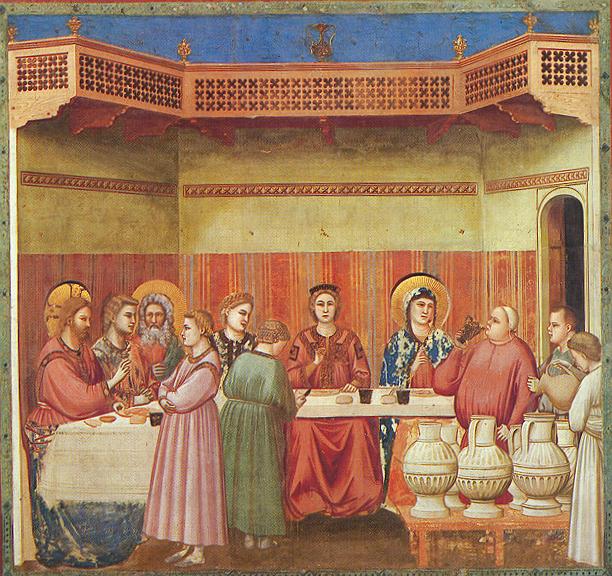
Marriage at Cana by Giotto (1266-1337)

~ A MOTHER KNOWS HER CHILD ~ 

Recently our small study group focused on the second chapter of John.  There is a moment that I love in this account. It happens during an interaction between Jesus and his Mom at the wedding in Cana.  Mary has just told Jesus that the party is out of wine when Jesus responds,  “Woman, why do you involve me? My hour has not yet come.” (Jn 2:4)  To our western ears, this sounds a bit curt to say the least, but an NIV footnote explains that in the Greek the comment does not denote any disrespect. What delights me, is Mary's response. Most any Mother with grown sons can identify the special relationship glimpsed here.  She knows her son.  She doesn't argue or cajole or insist that he help.  She doesn't need to.  This man is her boy. The one she taught to walk and talk and modeled how to live. What wonderful parent child familiarity here!

Out of a deep well of knowing her son, Mary responded in a manner echoed timelessly over the centuries.  She ignored his protests and simply turned to the servants, confidently instructing them to "do whatever he tells you." (Jn 2:5)  She may not have known just what Jesus would tell them, but she was aware he could do something and trusted him to do it. 

I love how Jesus did not ignore her words.  His initial response may seem dismissive to us, but his actions show respect.  He did tell the servants what to do.  And the water they fetched was turned into excellent wine.  Mary must have marveled!  And tucked this into her heart along with all the rest she had to ponder.

Can any mother look at her grown child and not be aware, even if subconsciously, of the gifts she watched emerge?  The hopes and fears and promise as she watched her child develop?  Even in a world where a woman is not deemed to match the intellect of men - is not highly regarded other than to bear sons for her husband's lineage, mothers know their sons. 

Mary knew.  Embedded in her being was the reality of the message that she carried within her even before she carried this child.  "You will conceive and give birth to a son, and you are to call him Jesus. He will be great and will be called the Son of the Most High. The Lord God will give him the throne of his father David, and he will reign over Jacob’s descendants forever; his kingdom will never end.” (Lk1:31-33)  Jesus' very name means savior, deliverer.  Mary knew her son was the promised Messiah, the Heir of God.  We learn that from her encounter and response to Gabriel. We see it confirmed in Elizabeth's welcome greeting.  And we hear her voicing the wonder of it all in her song of rejoicing.  “My soul glorifies the Lord and my spirit rejoices in God my Savior, for he has been mindful of the humble state of his servant.  From now on all generations will call me blessed…" (Lk1:46-55)

John's story offers an exquisite peek at these two sharing the moment when Jesus launched the first of many signs pointing to God's truth. The water to wine miracle which began Christ’s ministry is rich in symbolism and carries many overtones - and will appear again at its end when "one of the soldiers pierced Jesus’ side with a spear, bringing a sudden flow of blood and water." (Jn 19:34)* 

And Mary will again be watching.

JoMae
10/3/15

Blood, Wine and Water
*At the final supper before his death, Jesus took the cup and explained, "This is my blood of the covenant, which is poured out for many for the remission of sins." (Mt 26:28) See also Ex 24:3-8  where shortly after leaving Egypt the covenant between God and the Israelites is confirmed.  At the foot of Mount Sinai Moses taught the people God's instructions and wrote them all down  Then with the blood of sacrificed young bulls, "Moses then took the blood, sprinkled it on the people and said, “This is the blood of the covenant that the LORD has made with you in accordance with all these words.” (Ex 24:8)

July 04, 2010

Where are the Women?

WHERE ARE THE WOMEN?

The headline at the CRC's online news page for Synod 2006 reads: "Synod Votes to Remove 'Male' As Qualification for Office."  The story begins as follows: "June 15, 2006, Grand Rapids, Mich. - Synod 2006 took another step toward making all ordained offices in the Christian Reformed Church available to women, but with hesitation. Synod voted to remove the word 'male' from the qualifications for ecclesiastical office listed in the Church Order, opening the way for women to be ordained as ministers of the Word, elders or ministry associates.  But the decision needs to be adopted by Synod 2007 before it takes effect."

It goes on to mention the stipulations binding the decision, "Synod also imposed provisions that women ministers or elders would not be permitted to serve as delegates to synod or as synodical deputies." Stunning as this information is, it fails to reveal the gordian knot by which the favorable news for women (deleting the word male) is married to the negative (no female delegates or deputies.) The trick is, the two rulings are intricately woven together with the words "provided that." The recommendation reads in part, "that the word male be deleted ... provided that ... women ministers and elders not be allowed to serve ..."

Good news is cancelled out

The online report ends with synod asking for seven years of silence on the subject. "Finally, synod encouraged the church to "undertake a Sabbath rest of seven years following the adoption of these changes ... before revisiting this action in the assemblies." So the headline which at first glance appears to be good news, is quickly cancelled out by the rest of the story.

Prior to Synod's discussion of women, I was familiar with the requests of Overture 5 - that the word male be deleted from Church Order Article 3a and that delegation of women office bearers to synod be permitted. I had also read the Board of Trustee's advice for clear leadership, as printed in the supplement to the Agenda for Synod. It concludes: "The Board sees no benefit in synod's responding ambivalently to the proposed change and advises synod to speak clearly for the change."

I had the report of Advisory Committee 8B at hand in preparation for the debate. So the evening of Thursday, June 15, found me glued to the video webcast on my computer screen. I watched as delegates listened to passionate testimony about how a spirit of unity had pervaded the committee as they prayed for guidance and worked to form a single recommendation rather than a majority/minority report. A dramatic plea spoke of the Holy Spirit's role in the compromise they arrived at and urgently encouraged unanimous approval of it. It was a powerful introduction to their work. Watching, I almost felt that a vote against, would be a vote against the work of the Holy Spirit. Almost. Because the recommendations in front of me just didn't make sense.

Men speak eloquently against exclusion

At 8pm, only an hour after the report had been introduced, and after only about ten speakers (all, I believe, spoke in favor,) the question was called and my heart sank. Strong objections emerged immediately, however, and men who had held back out of respect for the climate of unity which had been presented, now began to speak eloquently against the demeaning exclusion of ordained women to full participation in their office. Arguments from both sides flew back and forth. I heard biblical references such as Jacob waiting seven years for Rachel! (Did he wait seven years to exercise his rights?) I was appalled. Even the notion of a seven year sabbath rest was confusing. Is a "sabbath rest" seven years long? I continued to watch and listen in dismay and disbelief until the vote was taken about three hours later and the recommendations of the advisory committee, though some were modified, basically passed.

The first recommendation was approved 112 - 67 with one abstention. The word male will be deleted from Church Order Article 3a, but at a great price. Last year's provision for female synodical deputies will be withdrawn and women will not be permitted as voting delegates at synod. Two grounds are given for this. The first speaks of "honoring and respecting on the synodical level those who oppose women serving in the offices of minister or elder." It does not mention that this "honoring and respecting" is at the expense of dishonoring and disrespecting those who advocate women serving in these offices.

The second ground points out that both perspectives as to whether or not women are allowed to serve as minister and elders are "within the bounds of biblical authority and Reformed theology." Both the removal of the word male from Church Order 3a and the retention of an all male synod are based on this declaration. How can this be defended? How can one be prevented from serving on the synodical level when her ordination is "within the bounds of biblical and Reformed theology?"

A huge step back

The reversal of last year's acceptance of female synodical delegates is a huge step back for women ordained in the CRC. Considering the restrictions imposed, have women gained anything by the vote to remove the word male from Church Order 3a? Will this change force classes to accept women? Or congregations to elect us? It is hard to see any progress in this decision.

The rest of the recommendations of Advisory Committee 8B sought to nail the details of the above changes firmly into the Church Order where if ratified they would be very difficult to change. One small hopeful note concerning this is that some of these, such as #3: "No classis shall delegate a woman minister or elder to synod," and #4: "No woman shall be nominated by a classis (or appointed by synod) as a synodical deputy," were amended to be placed in the supplement to the Church Order rather than in the Church Order itself. The significance is that the supplement can be modified more easily.

The effort to strong arm our women to stay on the sidelines and the extent to which it was successful, leaves me discouraged and angry. The request in recommendation #7 for a seven year hiatus on the subject represents one more painful twist in this power play.

How will women respond?

Now the question is, what will Synod 2007 do? Will they ratify the deletion of the word male from the Church Order? Will they remove these 2006 changes to the supplement? Will they overturn the encouragement of a seven year silence? Perhaps the larger question is, how will our women respond? Will we be willing to send a loud and clear message as to female leadership abilities and our power to insist on change?

Synod declared these recommendations to be its response to Overture 5. What will be the response of the women of the Christian Reformed Church? At Synod some women spoke in favor of these limitations. Is that the belief of the majority of our women? Perhaps this is the time for more CRC women to become active leaders in our denomination. To take a stand and raise our voices on our own behalf. Without asking permission. Without waiting to be told we are allowed.

Challenging all women

I'd like to challenge the women who care about this issue to each choose at least one expression of their determination for change. Whether that is monitoring her classis, writing letters to the Board of Trustees and/or the Banner, finding other directions for some of our tithing during Synod's "sabbath rest" or taking a sabbatical of our own from some of our congregational involvement.

Women do have power. As Christians, we are hesitant to use that power. It would rock the boat. It might hurt our families. It would hurt our congregations to lose teachers, to lose committee chairs, or to lose financial support. We don't want to seem pushy by sticking our nose into the business of a classis where we are not wanted. Yet if each woman used her power in some small way, to make Synod recognize, value and utilize the untapped wisdom of the female half of our denomination, this would be a valuable gift to the Christian Reformed Church.

The majority of Synod just doesn't get it! We are wasting resources. We are wasting wisdom by not embracing the leadership potential of our sisters in Christ. This is folly. Women do a huge amount of the work in our churches. We have illustrated our gifts of leadership in countless ways. When our women hear of this latest insult to our integrity and capability to govern our denomination along with our brothers, I hope many will speak out.

-JoMae Spoelhof
       6/26/06


Written 6/26/06 and published in Christian Courier

Samson's Mother

SAMSON'S MOTHER - A WOMAN OF CONFIDENCE

Imagine this woman.  Married yet childless.  She is an Israelite living in the days of the judges - about one thousand years before the Angel Gabriel would appear to young Mary the mother of Jesus.  And roughly half way between that event and the announcement of the impending birth of Isaac in his parents' old age.  Only a few centuries have gone by since the Children of Israel have been freed from four hundred years of slavery in Egypt.  We are given no name for her other than that she is the wife of Manoah of the tribe of Dan.

One day the angel of YHWH comes to her.  She is told, "Although you are barren, having borne no children, you shall conceive and bear a son."  The angel instructs her to "be careful not to drink wine or strong drink, or to eat anything unclean."  Then come instructions about how to raise her son.  "No razor is to come on his head, for the boy shall be a nazarite to God from birth.  It is he who shall begin to deliver Israel from the hand of the Philistines."

What an amazing moment for this woman!  Was she afraid?  Did she speak?  All we know is what she later tells her husband.  That a man of God came to her looking like an angel of God and very awesome.  She reports,  "I did not ask him where he came from and he did not tell me his name."

In contrast to God's similar announcement to Abraham and Sarah, Manoah was not there - not even within ear shot.  This wonderful news was delivered to his wife alone.  Part of what I admire about this woman though, is that she did not harbor this encounter to herself.  She goes to Manoah and repeats the information.  There is a sense of companionship and mutual respect among these two.  A sense which continues throughout the story - even when Samson is grown and they are concerned about his selection of a wife from among the Philistines.  Unable to dissuade him, they go together to meet this girl.  And later travel again to attend the wedding.

Going back to the announcement, however, it strikes me that Manoah believes his wife's strange tale.  He doesn't doubt her or wonder if she is imagining things.  His response is to entreat YHWH to "let the man of God whom you sent come to us again and teach us what we are to do concerning the boy who will be born."

The Bible tells us that "God listened to Manoah, and the angel of God came again to the woman as she sat in the field; but her husband Manoah was not with her."  Clearly the mother of this special child is sought out to be the first line of contact about this important event.  This time, however, the woman hurries to get her husband and coming to the angel, Manoah gets to ask his burning questions.  After verifying that this indeed is the one who had spoken to his wife, he inquires,  "Now when your words come true, what is to be the boy's rule of life; what is he to do?"

According to the account we have in Judges 13,  Manoah is the only one who speaks to the angel,  yet his wife is the only one entrusted with instructions on raising the child and details about his destiny.  Twice she is sought out for a visit.  Twice Manoah asks about how to bring up the child.  All he is told is to follow the instructions given to his wife.  They are not repeated for him, although the angel does repeat for him the food and drink his wife must avoid. 

After this conversation, Manoah invites the man of God to stay so they can prepare a kid to eat.  The angel will not eat, but suggests they make a burnt offering to YHWH instead.  Manoah then asks for the name of their visitor, who replies,  "Why do you ask my name?  It is too wonderful."  We read that in all of this exchange, Manoah did not know this was the angel of YHWH. 

Finally, Manoah makes a sacrifice of a young goat and a grain offering.  As the flames rise toward heaven from the altar, their visitor ascends in them and disappears - while the man and his wife fall to their faces on the ground. 

At this point Manoah realizes to whom he had been speaking.  That this was the angel of YHWH.  "We shall surely die, for we have seen God," he says.  But his wife calmly answers,  "If the LORD had meant to kill us, he would not have accepted a burnt offering and a grain offering at our hands, or shown us all these things, or now announced to us such things as these." 

Here we see the deeper understanding of this Israelite mother, her quiet confidence and the respectful camaraderie of this couple.  Later, when this woman bears her son, she will name him Samson.  He will be a powerful mix of service to God and pain to his parents.

Some have noticed that Samson's mother does not seem to have told Manoah what their child will grow up to do. I wonder why this piece of information entrusted to her seems to have been kept from him at first.  I wonder if she was sparing him some worry, as mothers to this day are wont to do. 

Did you ever study this articulate woman as a child?  Have you heard her story preached?  Her life, so honored and sought out by God, celebrated?  Would that I, in this era where I am free to speak and think for myself, can model some of her attributes.  As a parent, as a partner, and as a woman following the Christ.

-JoMae Spoelhof

Written 2/14/04 and published in the 3/15/04 issue of Christian Courier

Women of the CRC

Women of the Christian Reformed Church
  - A Short History

On a recent Sunday while visiting in Grand Rapids, Michigan,  I worshiped at Eastern Avenue Christian Reformed Church (CRC).  There I ran into and was reminded of women who had participated at ground level in the search for gender equality in the CRC.  Some answered the call to build a network of encouragement and education concerning equal partnership. Another answered the call to attend seminary so she could preach God's Word.  This old congregation in the heart of the city has long been an advocate for men and women serving God together. I heard a good sound sermon that morning, preached by Rev. Thea Leunk. 

 I recall CW-CRC (The Committee for Women in the CRC) meetings held there - celebrating small steps achieved in the early '90s, and grieving large steps back - also in the '90s.  And I smile to think that one of the earliest stories concerning the journey of women in the CRC also involves that church.  For the tug of war to keep our women in the kitchen began years ago, before most of us were born.  Way back in the early 1900s, when U.S. suffragettes were determined to vote, men of the CRC were vigorously in opposition.  But already then, some men spoke out for equality. 

One such early advocate, was Rev Johannes Groen, pastor of Eastern Ave CRC.  Much heated discussion about why women should not vote was being carried on by CRC leaders in the Banner and the Grand Rapids newspapers.  On a Tuesday evening, April 1, 1913, against this background, Rev. Groen spoke to a large gathering in support of women's suffrage.  In 1984, Mr. Nick Huizinga wrote an extended article on these debates for the CW-CRC Newsletter, spelling out the arguments and the price an advocate paid in this bitter climate.  The 1914 Synod even appointed a short lived committee on women's suffrage. Two years later the report came back recommending that the church should not concern itself in this question. The first reason given was, "The Word of God gives no rule for suffrage, and consequently no rule in relation to suffrage for women."

Later however, the subject did become a matter for Synod.  Women who had been voting since 1920, began asking to be included in the decisions of their congregations. By 1947 Synod was looking into this question.  In those days, while there was no direct rule in the Church Order against allowing a woman to vote, it was assumed by deep set traditions which were explained in the Church Order Commentary.  Finally, in 1957, after years of opposition, Synod allowed congregations to let their women vote.  It took another 50 years for all CRC congregations to include the women - if they all do now.

But something even more significant began to happen during this time.  The Church Order was to be revised. According to the Index of Synodical Decisions, this was requested already in 1950 and dealt with at several Synods during the decade.  In 1965, the Revised Church Order was adopted. A significant change appeared in Article 3 at this time. A new word "male" was now embedded in the requirement for ordination. For the first time, language which might have been generic was rephrased to leave no doubt.  In the language of the day, "man" or "men" often meant "people" and included women. For example,  In the 1954 edition of the Church Order, anyone in need of discipline was called "he" inclusively.  "He" was understood to mean he or she - except when it didn't. 

By 1965, CRC women were not only voting in increasing numbers in their congregations, other Reformed churches in fellowship with us were beginning to consider the ordination of female deacons.  Our leaders took great care to nail down their position.  Like a sword deeply thrust, that little word "male" has so far been impossible to remove.  To this day it bars the door to Synod - even for women duly ordained in the Christian Reformed Church. 

In 1963, the Reformed Ecumenical Synod of which the CRC was a member, appointed a committee to examine the exclusion of women in ordained offices of the church.  By 1968 each member denomination was encouraged to evaluate the question concerning the office of deacon, and by 1970, our Synod appointed a committee with instructions to report in 1972.  There followed annual debates and new questions and committees to examine them…  Are unequal roles divine law or cultural? What is the meaning of ordination? Is there biblical proof for exclusion?  There were questions about hermeneutics, creation order, and headship.  Then, in 1978, Synod allowed women to be deacons as long as the role was distinct from that of elders.  Ratification failed however, and the debate continued until final approval in 1984.

The overtures and protests which followed, led to more in-depth study of headship.  According to the helpful booklet Women in Office which the CRC published in 1990 to review the process, Synod 1987 called for a "…further reasoned study on the biblical and confessional basis for extending the 'headship principle' from marriage to the church." (Acts of Synod 1987, p 646) 

The committee's mandate had two parts, and its response in 1990 launched the struggle that would define the next fifteen years as advocates for gender equality rejoiced and wept repeatedly when decisions were made and undone over and over in our quest for women to participate fully in the privileges and responsibilities of our denomination.  The report said:  "Part A ...assumes that the headship principle in the church is based on an extension of the headship principle in marriage.  This no synod has affirmed ...  Part B ... assumes that the headship principle entails the headship of all men over all women in the church.  This no synod has ever declared" (Agenda 1990, p 329).

Synod 1990 discussed this report and the advisory committee's recommendations and decided with a 99-84 vote to permit churches to use their discretion in utilizing the gifts of female members in all the offices of the church. Further, synod changed the Church Order to delete the word male from Article 3a. It was an unexpected decision and led to much joy.  It also led to challenges in 1991 and to a decision not to ratify in 1992. That loss was 109-73.  For the next few years, advocates for each side fought with political agility over the removal of one little word which had by now become a deeply entrenched thorn. Synod 1993 overturned the '92 decision with a 95-88 vote which reinstated the rule to remove the word male from Article 3a, only to have ratification fail in 1994 by a vote of 95-89. 

Synod 1995 reacted strongly to the basis  of  the '94 decision which stated, "The clear teaching of Scripture prohibits women holding the offices of minister, elder and evangelist."  Such an argument ignores years of work by previous synods.  For decades many study committees had grappled with this question. Clearly, the answer was not clear!

The resulting outcry was yet another reversal.  Only this time Synod broke the cycle that required ratification.  Rather than going back to the effort to change Article 3a, the committee advocated a plan to allow Classes to declare the word male inoperative.  This argument was successful and was passed as a supplement rather than a permanent change to the Church Order.  It would take effect immediately, but at the price of several compromises.  Among them, further discussion would be closed for five years and women would not be allowed to be voting delegates to synod. 

Five years later the ban on women at synod was not lifted, and to the great disappointment of many, the 2005 synod did not lift it either.  Some adjustments have been made whereby congregations who wished to ordain a woman in spite of being in a classis which banned them, would be able to make arrangements to do so. Seven women are sent to Synod each year as non- voting advisers similar to the role of ethnic advisers (except this year only six were appointed).  And classis may appoint women to be synodical deputies as long as long as there are male alternates in case people are offended.  But as to the bottom line, a woman's right and responsibility to vote, it appears that until we can convince more classes to accept women, the matter is closed.   Synod 2005 voted to "revisit the issue of female delegates to synod at such a time when a majority of classes has declared the word “male” inoperative." At this point I count 22 out of 47 classes accepting women.

So, how far have we come?  Ten years after the ordination of women as ministers of the Word first began, the Synod of the Christian Reformed Church remains all male.  We have growing numbers of ordained women, yet none may help to shape the denomination with her presence and her vote. For many who have long worked toward full participation, this latest decision is painful. 

Yet there is a bright side.  We know the day will arrive! For momentum has continued  since those early days in 1912.  But even more exciting is the picture that is emerging against that day. In the past thirty years hundreds of CRC women have been studying theology.  Not all seeking ordination.  Not all at Calvin Seminary, yet thanks to these students, the theological insight of our people is maturing.  Even with some of our daughters leaving the CRC to be ordained, there is an impact on their families to see them rise and answer God's call on their lives.  And those who studied and stayed.  What a quiet influence they are having in our midst.  The balance is changing and young children in the church are enriched by that. These newly educated women are able to teach with a knowledge and wisdom our fore mothers did not have access to.

But the greatest joy to celebrate is this.  In the 2000 yearbook I counted seven ordained women. By 2005 that number had increased to 26 - not counting 2005 candidates and others ordained - or soon to be - during 2005.  At least seven more by my count so far.  The emergence of theologically educated CRC women is so encouraging.  As more and more of us in the coming years will call our pastors “she”, our sons and daughters will grow up seeing that male and female are equal to serve in God's family. 
 .
Yet there remains that fundamental flaw.  An inequity that must be changed.  Our women who preach the Word, administer the sacraments or serve as our elders, must be allowed to vote and help shape the future of our denomination.  Women may not yet have the power of the vote to participate in the decisions of the CRC, but like those to whom we are indebted for the right to vote for our countries, we do have a voice.  Let us use that voice.  To share ideas.  To speak to our pastors and other church leaders.  To join with other advocates until we open the floor of synod to all who are ordained to be there.  We need not sit back and be acted upon by others.  We are not impotent.  We must not be silenced.   Let us encourage the women who have answered God's call to preach and to lead.  Let us continue to move forward, writing and joining our voices in a great chorus until the walls of inequity tumble down and all in the CRC are one.

JoMae Spoelhof
September 2005


This article was published in the 10/24/2005 issue of Christian Courier

April 23, 2010

Mom's Hands


MOM AND ME - 1938

She held the whole world in her hands, my mother. As have the mothers of countless small children across the generations. She was my whole world at first - sprinkled soon with siblings and that other set of hands joined in holding us together. Four loving hands shaped my life. One pair cradled me to her soft breast and nursed me, the other later tossed me high above his head or wrestled most ferociously his laughing girl.

Two hands clasped mine tightly and swung me up over the puddles as we trudged through this forest called life. Mother's hand on one side; Father's on the other. Together teaching me about the One who truly holds the whole world in loving hands. Their hands fed me and provided, touched my heart and sometimes spanked. Their parental fingers prodded and molded and folded in prayer for me. I can almost feel my mother's palm resting on my head as I learned "Now I lay me down to sleep." (Or is it my palm and my child kneeling there?)

Mother hands. Father hands. Strong gentle hands. Each in their own way. Familiar on my face was their goodnight caress before I fell asleep. Each touch distinct. Each half of a whole that together taught me of God's parental love. In my experience, however, the most frequent touches came from my mother. As she measured a new dress or brushed my hair or washed my face or held my hand to cross the street. Father's impression was a bit more removed. He worked every day to provide for us. Mom worked every day WITH us. Both modeled God's love and provision, with Mom modeling God's nearness in a very immediate way.

Yet sadly, in my church and many like it, parental may only be spelled paternal. God's love to us is spoken of only as a father's love. We have been taught to know God solely as Father. It is forbidden to address God as Mother. As if the mother side of God's parental love does not exist, it remains invisible. So while I now recognize God's Mother love as surely as I know my mother's hand upon my cheek, I never, save in the privacy of my own soul, give voice to her. For our language portrays God as Father. He. Male.

I love being God's child. God's heir. I treasure Christ's love for me. Yet for years I only understood God as my Heavenly Father. What joy to know God is my Heavenly Mother too! How long, I wonder, until the unique touches of a mother are used to illustrate the lessons of God's love for us. How long before we see the One who holds the whole world carefully in hand as neither He nor She, but as our Mother/Father God. Our complete and perfect heavenly Parent.

JoMae
1/15/99